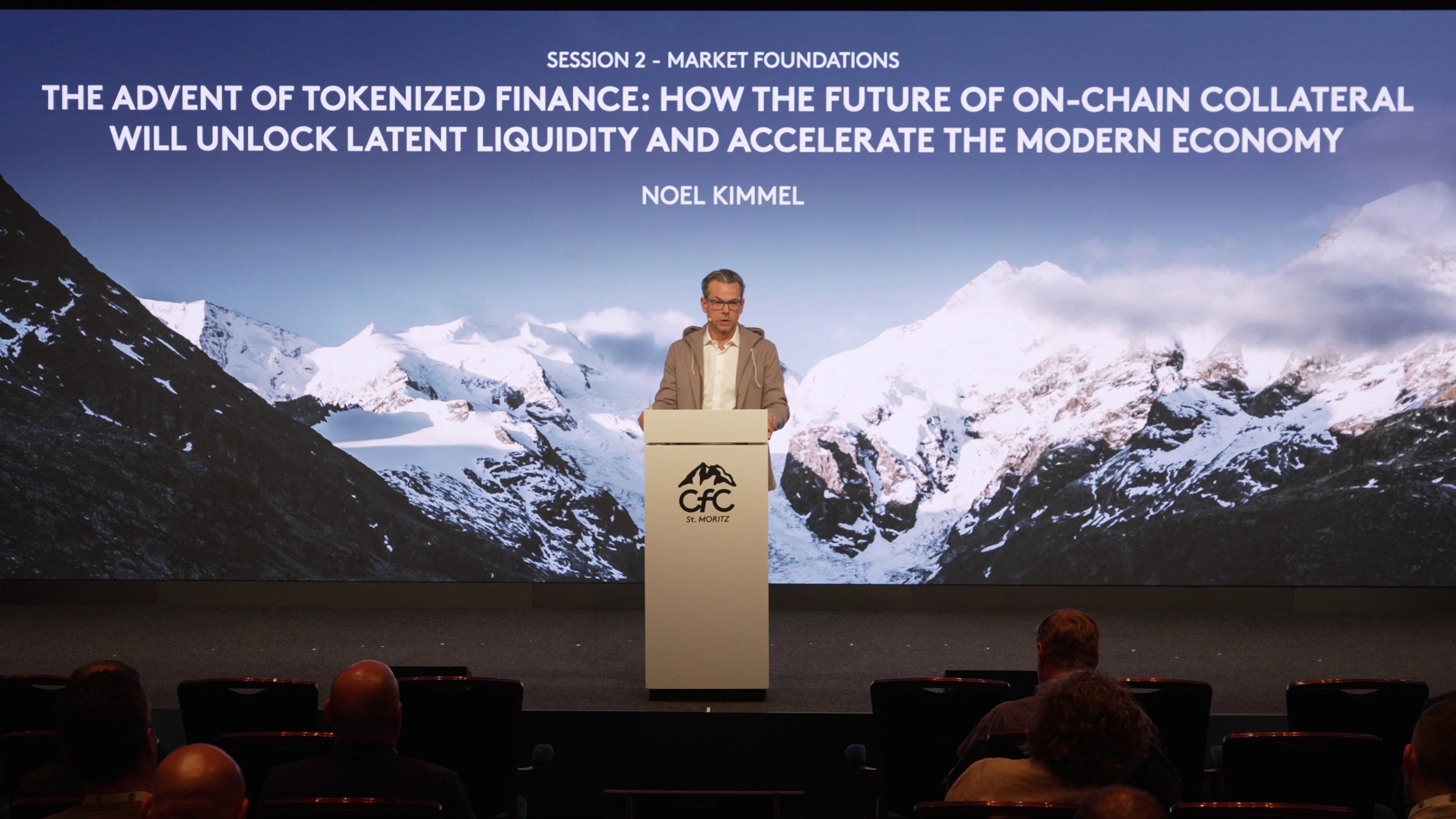
The Advent of Tokenized Finance: How the Future of On-Chain Collateral Will Unlock Latent Liquidity and Accelerate the Modern Economy
- Noel Kimmel
On-chain collateral is becoming a central tenet of modern financial markets.
Market forces include constrained balance sheets, capital efficiency demands, and a move to T+1 settlement.
“This is not TradFi versus DeFi – tokenized finance will not replace traditional markets.”
Addressing senior leaders from both the buy and sell side of traditional financial (TradFi) institutions who are navigating the transition to digital finance and blockchain technology, Kimmel emphasized the importance of tokenized finance, highlighting recent developments by major institutions such as JPMorgan, Citi, UBS, and BNY.
“Tokenized finance is not a parallel system operating outside TradFi markets,” he said. “It is an evolution of existing market infrastructure, unlocked for a modern financial operating system that is programmable, interoperable, and global.”
Kimmel believes that programmable on-chain collateral is fast becoming a central tenet of modern financial markets, claiming that “it is the backbone of connective tissue that will bind old and new.”
He examined the macro and market forces, such as constrained balance sheets, demand for capital efficiency, and the move to T+1 settlement. In his opinion, the ability to mobilize collateral, optimize liquidity, and settle transactions in real time have gone from ‘nice to have’ features to existential requirements.
“Tokenization reframes all these general needs. Manual reconciliation becomes real-time settlement, fragmented systems are bridged by capital mobility, and opaque risks are supplanted by transparent, programmable risk,” Kimmel said.
He argued that tokenized collateral is not merely a wrapper for assets – it is the foundational layer for the future. “It enables atomic settlement, simultaneous, certain delivery and payment, thereby reducing counterparty risk. It means intraday collateral mobility, with assets moving at the speed of code instead of paperwork,” he explained.
Smart contracts can enforce rules, automate margin calls, and release assets only when a set of predetermined conditions is met. Kimmel sees this as a profound evolution from static, locked-up collateral to programmable collateral, which is dynamic and responsive to the needs of today’s markets and market participants.
“This is not TradFi versus DeFi – tokenized finance will not replace traditional markets,” he added. “It is [embedding] the logic and discipline of traditional finance onto the rails of decentralized finance.”
He pointed to the fact that tokenized treasuries are now being used as margin, unlocking liquidity that was previously trapped on-chain. Repo and securities lending are also becoming a reality. In addition, cross-border payments are being transformed by programmable assets moving at the speed of the internet, which means liquidity that is not trapped in silos.
However, if integration lags, there is a risk of parallel infrastructure, as well as fragmented and trapped liquidity.
He outlined three critical enablers to a unified financial ecosystem: standardization, institutional-grade risk controls, and collaborative ecosystems.
According to Kimmel, collaborative ecosystems are important, as no single bank, syntax, or protocol can build them alone. “When collaboration meets innovation, we move beyond isolated pilots and build a foundation for a financial system that is faster and more efficient, but also safer, more inclusive, and more robust,” he said.
Recommended
-

- Meltem Demirors
Bringing the Data Center Economy Onchain
09:35 - 09:55 -

- Sheila Warren
- Sebastien Badault
- Chen Fang
- Christopher Tam
- Anthony Day
From Foundations to Fortification: Privacy, Security, and the Next Layer of Trust
09:55 - 10:35 -

- Denelle Dixon
- Lily Liu
- Anton Katz
- Alex Manson
- Antony Lewis
From Infrastructure to Investing: The Rise of On-Chain Capital Formation
12:00 - 12:40 -
- Kevin de Patoul
- Thomas Restout
- Chris Maurice
- Matt Stafford
- David Wachsman
Stablecoins and Financial Access: Emerging Roles in a Digital Financial System
12:40 - 13:20 -

- Scott Lawin
- Brad Garlinghouse
- Christopher Ferraro
- Antony Lewis
Oil and Water? Are Crypto Companies Compatible With Traditional Public Markets?
14:45 - 15:20 -

- Talia Klein
- Bhaji Illuminati
- Christine Moy
- Evgeny Gaevoy
- Michael Bucella
Reimagining Private Markets: Tokenization, Liquidity, and the Future of Alternatives
15:25 - 16:05 -

- Carlos Domingo
- John Nahas
- Amar Kuchinad
- Mathias Imbach
- Michael Bucella
Banking on Blockchain: Institutional Lending, Tokenized Assets, and the Evolution of Capital Markets
16:10 - 16:45 -

- Teresa Goody Guillen
- Lowell Ness
- Hyunsu Jung
- Vanessa Grellet
Crypto in Public Markets: Equity Exposure, Treasury Strategies, and Corporate Growth
17:05 - 17:40 -
- Evy Theunis
- Karl Naim
- Fernando Vázquez Cao
- Paul Frost-Smith
- Rachel Pether
From Parallel to Integrated: What Institutions Need to Fully Embrace Digital Assets
17:40 - 18:20


