
Bringing the Data Center Economy Onchain
- Meltem Demirors
The biggest infrastructure build-out in modern history is happening now
Best returns of the decade will come from energy, compute, and crypto
Framework for infrastructure investing: aggregate, orchestrate, optimize, and financialize
Half of the respondents to the CfC St. Moritz Pulse Survey believe that the key investment area in the next 12 months will be infrastructure. Investment in infrastructure is expected to reach USD 7 trillion by 2030. Therefore, if investors aren’t allocating to the energy, compute, and crypto value chain, they will miss out on the best returns of the decade, according to Demirors.
“The biggest infrastructure build-out in modern history is happening right now,” she said. “We’re nowhere close to a bubble – it’s just getting started, and the numbers are going to get insane.”
Demirors believes that Bitcoin is the blueprint for where the AI and data center industry is heading. “Bitcoin pioneers something essential, which is the energy to compute the value chain and the creation of money that is rooted in the laws of physics, ie, thermodynamics. Bitcoin is money that is created by thermodynamically scarce energy, which is converted into computation that creates a fungible global commodity,” she said.
Additionally, she said that the artificial intelligence (AI) boom wouldn’t exist if the world didn’t have Bitcoin capitalizing billions of dollars of data center build-out over the past decade. She also argued that proof of work beats proof of stake.
Demirors presented a framework for investing in industrial infrastructures, including: aggregating physical infrastructure resources; orchestrating to make physical infrastructure readable and programmable by computers; optimizing infrastructures at local, regional, and global scale; and financializing, for example, compute, memory and fiber perpetual swaps. She highlighted the potential for trading on-chain various assets, including compute, memory, and even payload costs for space missions.
Crucible, for example, is building compounding loops following this framework, according to Demirors. Starting with aggregation, in February, it is launching its own neocloud called Crucible Compute. In terms of orchestration, Crucible has invested in an orchestration company that embeds sensors into its rack architecture to gather real-time data on its GPUs to monitor and ensure residual GPU value. To optimize, it sold most of its compute in long-dated offtake contracts, as well as selling spot in different markets and doing compute to equity swaps.
Crucible is also creating new financial products and markets to help the company price and transfer risk in new markets, such as futures, buyer credit default swaps to guarantee against bankruptcy from compute buyers, which are AI startups, and residual value insurance products, creating on-chain insurance pools to take first loss, etc.
“We are going to use financial engineering on steroids on-chain, not for vaporware tokens, not for looping yield, but for the infrastructure economy,” she said.
And data centers are just the beginning. In the last six months, Crucible has invested in rare earths, critical metals, nuclear fuels, and solar panels for space. “There are no limits to how far we can go,” said Demirors. “If we can virtualize it and represent it as a token, if we can make this physical infrastructure compatible with computers, then we can trade it on-chain.”
Recommended
-

- Sheila Warren
- Sebastien Badault
- Chen Fang
- Christopher Tam
- Anthony Day
From Foundations to Fortification: Privacy, Security, and the Next Layer of Trust
09:55 - 10:35 -
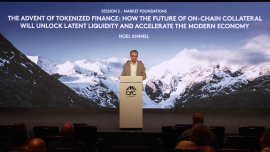
- Noel Kimmel
The Advent of Tokenized Finance: How the Future of On-Chain Collateral Will Unlock Latent Liquidity and Accelerate the Modern Economy
11:40 - 12:00 -
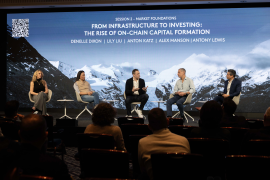
- Denelle Dixon
- Lily Liu
- Anton Katz
- Alex Manson
- Antony Lewis
From Infrastructure to Investing: The Rise of On-Chain Capital Formation
12:00 - 12:40 -
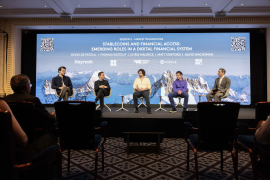
- Kevin de Patoul
- Thomas Restout
- Chris Maurice
- Matt Stafford
- David Wachsman
Stablecoins and Financial Access: Emerging Roles in a Digital Financial System
12:40 - 13:20 -

- Scott Lawin
- Brad Garlinghouse
- Christopher Ferraro
- Antony Lewis
Oil and Water? Are Crypto Companies Compatible With Traditional Public Markets?
14:45 - 15:20 -

- Talia Klein
- Bhaji Illuminati
- Christine Moy
- Evgeny Gaevoy
- Michael Bucella
Reimagining Private Markets: Tokenization, Liquidity, and the Future of Alternatives
15:25 - 16:05 -

- Carlos Domingo
- John Nahas
- Amar Kuchinad
- Mathias Imbach
- Michael Bucella
Banking on Blockchain: Institutional Lending, Tokenized Assets, and the Evolution of Capital Markets
16:10 - 16:45 -

- Teresa Goody Guillen
- Lowell Ness
- Hyunsu Jung
- Vanessa Grellet
Crypto in Public Markets: Equity Exposure, Treasury Strategies, and Corporate Growth
17:05 - 17:40 -

- Evy Theunis
- Karl Naim
- Fernando Vázquez Cao
- Paul Frost-Smith
- Rachel Pether
From Parallel to Integrated: What Institutions Need to Fully Embrace Digital Assets
17:40 - 18:20


