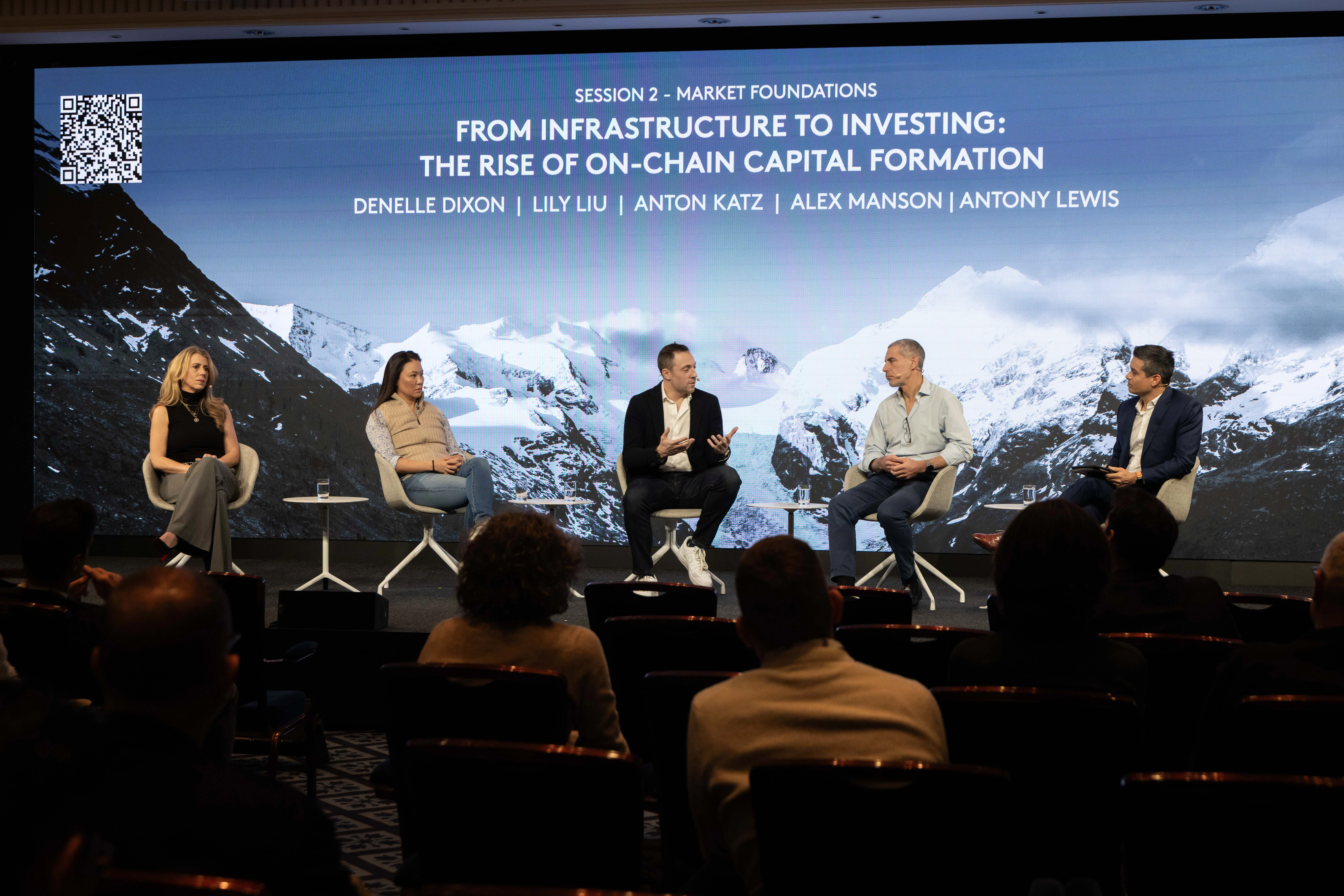
From Infrastructure to Investing: The Rise of On-Chain Capital Formation
- Denelle Dixon
- Lily Liu
- Anton Katz
- Alex Manson
- Antony Lewis
Better interoperability needed
Panelist looks to the ground-up community around shared financial infrastructure
Privacy on public infrastructure is important, but privacy must be balanced with the need for interoperability and security
Capital markets are gradually shifting towards more engagement with decentralized finance, putting interoperability and infrastructure considerations into focus as ties between the two worlds get stronger.
“I think we're past all the foundational points of what the infrastructure looks like. And we do need to see better interoperability amongst the change. We need to see bridges to be more available and to be secure across them,” Dixon from the Stellar Development Foundation said.
The panel discussed the pros and cons of private vs. public blockchains, weighing up security, privacy, and infrastructure challenges as well as the impact of regulation. Solana’s Liu said regulation, despite the more favorable tone, is proving to be a hurdle to building “truly open, decentralized systems today afresh.”
Turning to TradFi assets, Katz from Talos noted that the end goal is that all assets are digital assets. In order to move assets on-chain, the industry has to take the necessary step of adopting capital markets and some of its instruments to on-chain. Tokenization plays the role of providing backwards compatibility with the traditional sector. “I think without a doubt, we're headed to a native representation of assets on-chain, and that unlocks quite a lot,” he said.
He pointed out that it might not be useful to think of stablecoins as a different species with a different use case, noting that they are embedded in the asset class and their importance in the cash-led component of the native tokenisation of assets.
SC Ventures’ Manson argued that blockchain is not necessarily a silver bullet or a technology for improving everything. “I don't necessarily agree with that. I think that, you know, it's a phenomenal vehicle for settlement,“ noting that moving everything on-chain is not necessarily the answer.
Recommended
-

- Meltem Demirors
Bringing the Data Center Economy Onchain
09:35 - 09:55 -

- Sheila Warren
- Sebastien Badault
- Chen Fang
- Christopher Tam
- Anthony Day
From Foundations to Fortification: Privacy, Security, and the Next Layer of Trust
09:55 - 10:35 -

- Noel Kimmel
The Advent of Tokenized Finance: How the Future of On-Chain Collateral Will Unlock Latent Liquidity and Accelerate the Modern Economy
11:40 - 12:00 -

- Kevin de Patoul
- Thomas Restout
- Chris Maurice
- Matt Stafford
- David Wachsman
Stablecoins and Financial Access: Emerging Roles in a Digital Financial System
12:40 - 13:20 -

- Scott Lawin
- Brad Garlinghouse
- Christopher Ferraro
- Antony Lewis
Oil and Water? Are Crypto Companies Compatible With Traditional Public Markets?
14:45 - 15:20 -

- Talia Klein
- Bhaji Illuminati
- Christine Moy
- Evgeny Gaevoy
- Michael Bucella
Reimagining Private Markets: Tokenization, Liquidity, and the Future of Alternatives
15:25 - 16:05 -

- Carlos Domingo
- John Nahas
- Amar Kuchinad
- Mathias Imbach
- Michael Bucella
Banking on Blockchain: Institutional Lending, Tokenized Assets, and the Evolution of Capital Markets
16:10 - 16:45 -

- Teresa Goody Guillen
- Lowell Ness
- Hyunsu Jung
- Vanessa Grellet
Crypto in Public Markets: Equity Exposure, Treasury Strategies, and Corporate Growth
17:05 - 17:40 -

- Evy Theunis
- Karl Naim
- Fernando Vázquez Cao
- Paul Frost-Smith
- Rachel Pether
From Parallel to Integrated: What Institutions Need to Fully Embrace Digital Assets
17:40 - 18:20


