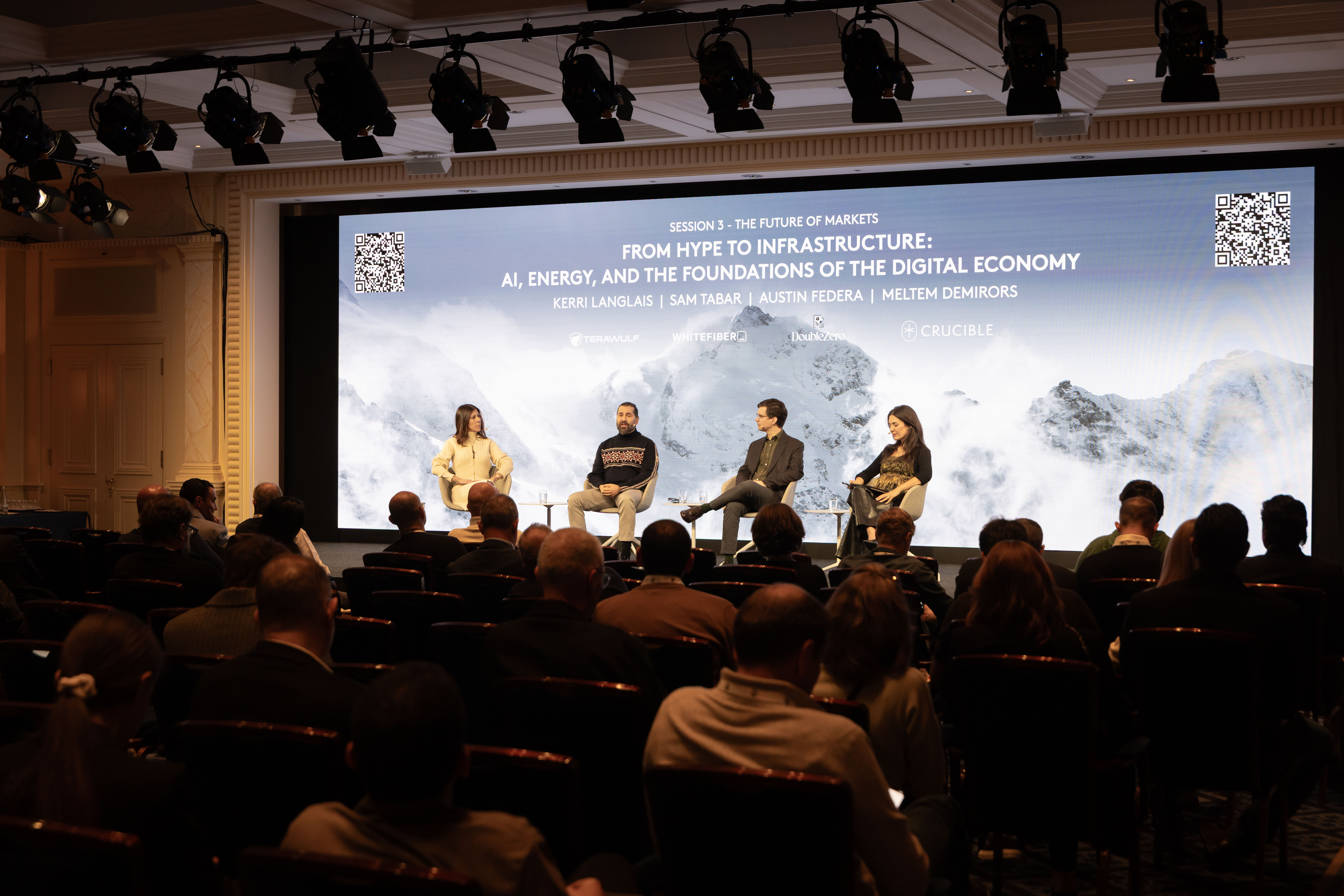
From Hype to Infrastructure: AI, Energy, and the Foundations of the Digital Economy
- Kerri Langlais
- Sam Tabar
- Austin Federa
- Meltem Demirors
There is a growing infrastructure convergence between AI and Bitcoin mining…
…but not all compute is created equal
Utilizing excess capacity in fiber networks can be used for creating high-performance systems
Digital assets and AI are converging on an infrastructure level as companies active in Bitcoin mining are also turning to providing energy and inputs for the compute-intensive process of running large language models.
Bitcoin miners have, over the past decade and a half, pioneered ways of accessing surplus and low-cost energy for producing more blocks of the digital currency, spearheading initiatives that saw miners set up data centers to use excess heat or other forms of leftover energy. As AI grows its influence, a new cohort of firms has joined the quest for low-cost energy, triggering a pivot from some miners.
TeraWulf is one such company, with Langlais saying the company has shifted from Bitcoin mining to building data centers for AI high-performance computing. The shift is changing the trajectory of investment and operations because, despite the similarities, there are key differences in terms of the demands of the two spaces.
“I think what Bitcoin mining taught grid operators is that you can have very large loads that you can turn up and down very quickly,” she said. “What we're learning is that not all compute is created equal.”
The race for abundant and cheap energy is also spurring companies like WhiteFiber to build new data centers, ideally by retrofitting existing infrastructure and converting it to their purposes. Tabar said one example of the latter approach is the company’s recent project that converted a former mattress factory into a data center.
“Greenfield builds are basically starting from scratch. You buy land and you're just literally starting from scratch to build a data center. We don't like that approach,” he said.
“We use an approach called retrofit, where we buy, for example, a mattress factory, which is what we did early last year, in February. We converted that into a tier three data center within six months, ahead of schedule, on budget, for a very sophisticated client.”
With a retrofit, the asset is up and running in six months, instead of the two years it typically takes for a greenfield project, reducing duration and project delay risks, he added.
Others, like DoubleZero make use of existing infrastructure and utilize excess capacity to create high-performance systems.
“We saw a real opportunity there with a bunch of underutilized fiber that a bunch of financial firms and technology firms have to create a system where we can effectively fractionalize that and make it available for many different types of users,” he said.
“And so being able to do that means that that incremental piece of fiber can earn proportionally more return at scale than [otherwise],” he added.
Recommended
-
- Jenny Johnson
- Staci Warden
The New Global Order of Capital: Investing through Transition and Transformation
12:40 - 13:20 -
- Carolyn Weinberg
- Joseph Lubin
- David Ripley
- Eva Szalay
Crypto and Capital in a Fragmented World: Dynamics, Risks, and Opportunities
13:20 - 14:00 -

- Caroline Pham
- J. Christopher Giancarlo
- Teresa Goody Guillen
The U.S. Regulatory Pivot: Global Signals from D.C.
14:30 - 15:00 -

- Deepa Raja Carbon
- Peter Kerstens
- Moad Fahmi
- J. Christopher Giancarlo
One Industry, Many Rulebooks: Bridging the Gap between Industry Needs and Regulatory Reality
15:05 - 15:40 -

- Fred Thiel
- Muneeb Ali
- Michael Bucella
Bitcoin’s Strategic Moment: A Global Asset in a Shifting Geopolitical Order
17:40 - 18:20 -

- Don Wilson
- Richard Teng
- Yuval Rooz
- Eva Szalay
From DeFi to On-Chain Capital Markets: Building the Next Financial System
18:20 - 19:00


