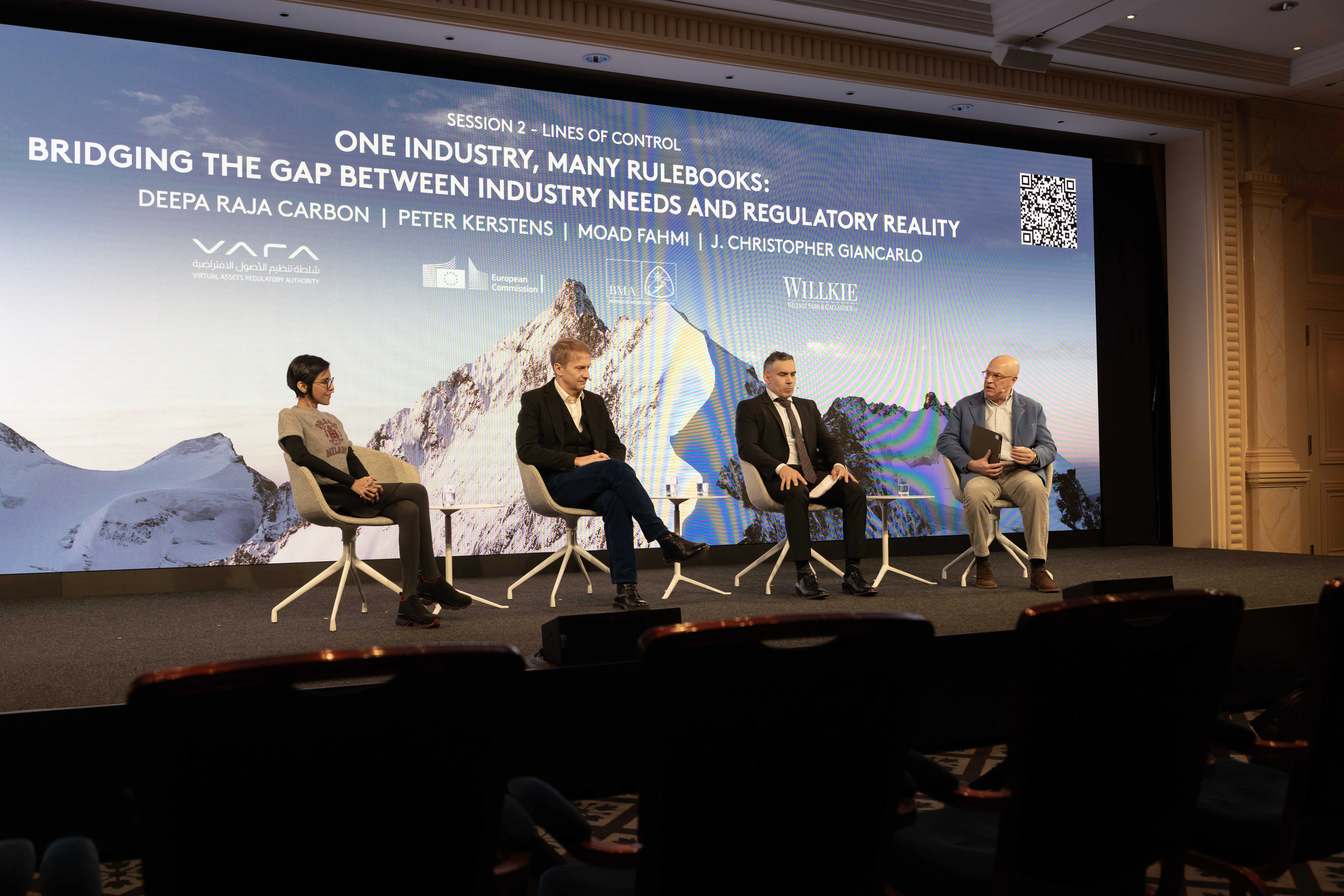
One Industry, Many Rulebooks: Bridging the Gap between Industry Needs and Regulatory Reality
- Deepa Raja Carbon
- Peter Kerstens
- Moad Fahmi
- J. Christopher Giancarlo
“If [the EU] continues to resist blockchain, we may not have any capital market left to unify,” Kerstens
Blockchain and tokenization will become the new market infrastructure
2026 will see a convergence between trustless and trusted ecosystems
Despite similarities in the US GENIUS Act and the EU’s Markets in Crypto Assets (MiCA) regulation, the intentions behind the two are vastly different: European regulators are using MiCA to control or limit stablecoins, while the US is using its regulation to promote stablecoins. This is according to Kerstens, for whom the question is whether the EU wants to have a blockchain-based financial market or prefers to hold back the technology.
“I believe that blockchain and tokenization will become the new market infrastructure. If we continue to resist blockchain, we may not have any capital market left to unify, and could become a flyover zone [between other jurisdictions],” he warned.
Fahmi, for one, is pleased that the US is changing its attitude towards digital assets and that this change is facilitating financial players globally. “Everyone at some point relies on a US stakeholder, either an audit firm or bank, and these stakeholders have changed their attitudes,” he said. “That means that the markets hopefully won’t be as fragmented in the future as they are today.”
Bermuda takes a principles-based approach to regulation and has worked at building trust across stakeholders, not only the financial industry and customers of digital asset firms, but also among the international regulatory community. This approach is seen as a model for other jurisdictions to follow.
When asked whether global standards were possible, Raja Carbon highlighted the difference between interoperability and harmonization. She explained that due to diverse requirements and priorities for each economy, the aim should be to create a level of trust and interoperability across different national systems.
“The principles can be similar, but I am going to nuance it for what’s best for my market,” she said. “I don’t think we should ever try to minimize [differences] to the extent of having a global set of standards that applies to everyone. That’s just not a realistic possibility.”
Fahmi agrees. “A global rulebook could be detrimental. I think there is value in having differences, and it makes the whole world more resilient. However, not having a global rulebook doesn’t mean that we don’t have common goals.” He added that adopting a principles-based approach is the best way to accommodate innovation.
Raja Carbon outlined three predictions for 2026. First is the advent of open-architecture infrastructure and the shift from an asset class to mainstream infrastructure for capital markets. Second is the convergence between a trustless and a trusted ecosystem. Third is the tokenization of traditional economy assets, such as real estate, health data, and insurance.
Kerstens believes that the application of distributed ledger technology in traditional financial markets is the future, but is less bullish about cryptocurrencies. “In a few years time, the crypto market will be a sideshow because no matter how successful Bitcoin is, it’s never going to reach the size of the global bond or equity markets,” he said.
Recommended
-
- Jenny Johnson
- Staci Warden
The New Global Order of Capital: Investing through Transition and Transformation
12:40 - 13:20 -
- Carolyn Weinberg
- Joseph Lubin
- David Ripley
- Eva Szalay
Crypto and Capital in a Fragmented World: Dynamics, Risks, and Opportunities
13:20 - 14:00 -
- Caroline Pham
- J. Christopher Giancarlo
- Teresa Goody Guillen
The U.S. Regulatory Pivot: Global Signals from D.C.
14:30 - 15:00 -
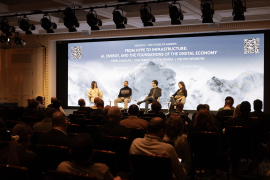
- Kerri Langlais
- Sam Tabar
- Austin Federa
- Meltem Demirors
From Hype to Infrastructure: AI, Energy, and the Foundations of the Digital Economy
17:00 - 17:40 -
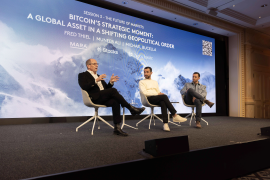
- Fred Thiel
- Muneeb Ali
- Michael Bucella
Bitcoin’s Strategic Moment: A Global Asset in a Shifting Geopolitical Order
17:40 - 18:20 -
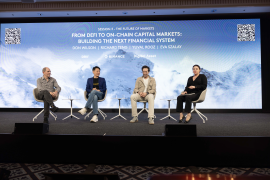
- Don Wilson
- Richard Teng
- Yuval Rooz
- Eva Szalay
From DeFi to On-Chain Capital Markets: Building the Next Financial System
18:20 - 19:00


