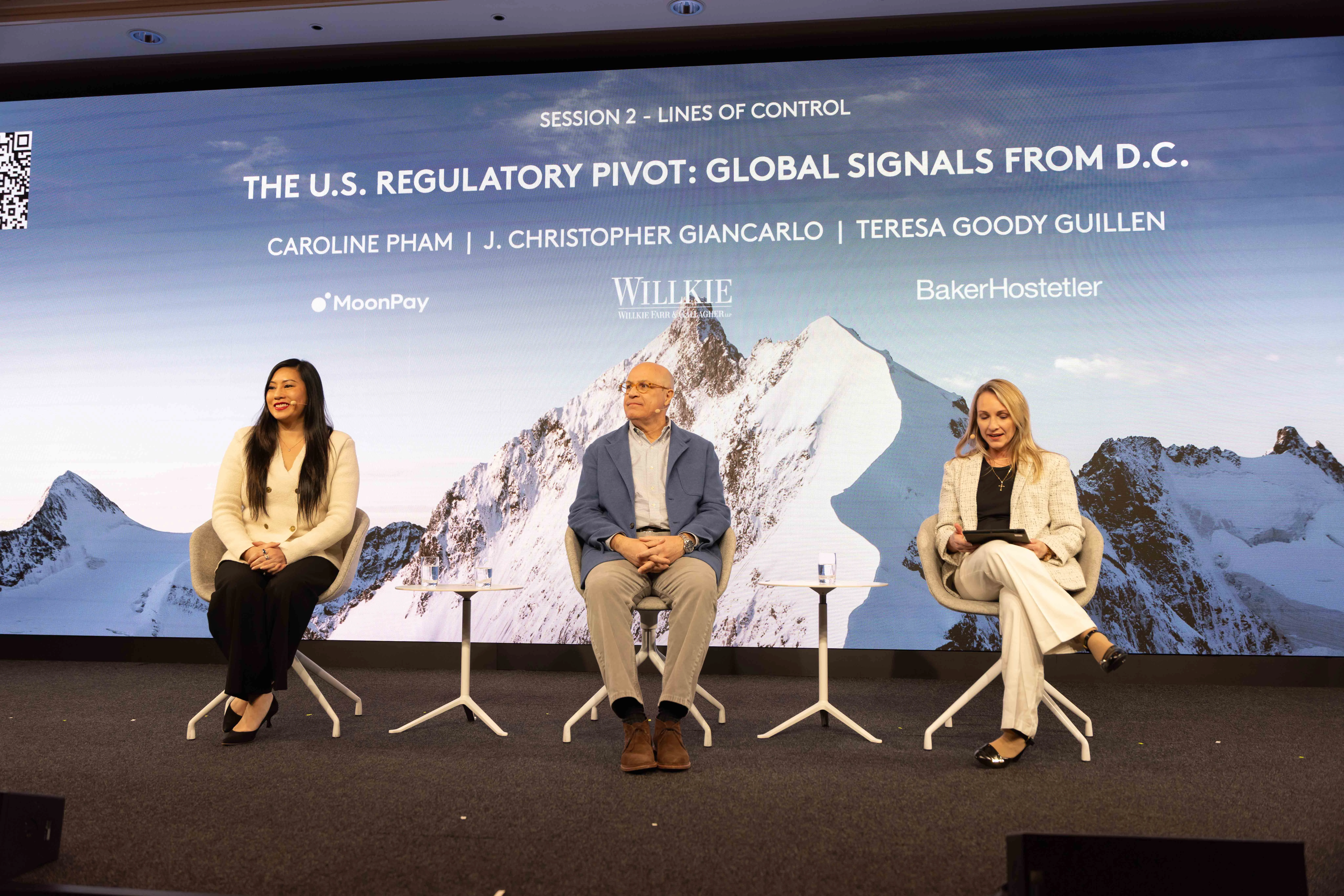
The U.S. Regulatory Pivot: Global Signals from D.C.
- Caroline Pham
- J. Christopher Giancarlo
- Teresa Goody Guillen
Building optimism about regulatory clarity in the U.S.
Multiple regulators in the U.S. are not a competitive disadvantage because they can go deep, translating into more efficient capital markets
Combining the SEC and the CFTC would save the government $7 million, but could weaken its competency edge
Two former CFTC Commissioners emphasized the need for further regulatory clarity in the U.S. and highlighted the strong momentum gathering in the merging of TradFi and Defi after the administration pivoted to its current, more friendly stance.
“What the industry has been faced with for the last four years in the United States is the risk of enforcement simply because they created something that hadn't been created before,” Giancarlo said.
The panel expressed optimism at the draft legislation of the Clarity Act released by U.S. senators this week, calling the development “critical.” Giancarlo pointed to three outstanding issues, namely the issue of DeFi, how much leeway DeFi will continue to have, and how much of it will be brought under regulatory supervision.
For now, it looks like a “rough compromise” is in place, he said, noting that there is reason for optimism.
“I think the crypto community and the Banking Committee may be able to settle on this, although we'll see. It's important that we get Clarity done, so that the issue of regulatory uncertainty and regulatory risk is removed from the scene,” he added.
Pham, meanwhile, said that if the language of the draft remains as it is, it “should not really be too disruptive,” adding that she hopes progress is made soon, ahead of any change in the political environment after the U.S. midterms. She also added that getting the rules finalized will avoid different versions of the rules emerging.
“I do think the one most important thing for Congress to get done, if nothing else, is to establish federal pre-emption for digital assets that are financial activities, because right now you have this conflict where you have all the states taking different interpretations,” Pham noted.
Panelists said existing regulations already address traditional risks of information asymmetries and market manipulation. While the panel agreed that the U.S. remains the flagbearer for change and regulation in capital markets, they questioned whether designated regulators for different business areas (securities, commodities, etc.) were an advantage or a hindrance to change.
Giancarlo argued that the system of multiple agencies contributed to the success of the U.S. as a leader, as it allowed rulemakers to go deeper. He noted that while in office, he commissioned a study about the impact of combining the SEC and the CFTC, which showed the government could save as much as $7 million.
Recommended
-

- Jenny Johnson
- Staci Warden
The New Global Order of Capital: Investing through Transition and Transformation
12:40 - 13:20 -

- Carolyn Weinberg
- Joseph Lubin
- David Ripley
- Eva Szalay
Crypto and Capital in a Fragmented World: Dynamics, Risks, and Opportunities
13:20 - 14:00 -

- Deepa Raja Carbon
- Peter Kerstens
- Moad Fahmi
- J. Christopher Giancarlo
One Industry, Many Rulebooks: Bridging the Gap between Industry Needs and Regulatory Reality
15:05 - 15:40 -

- Kerri Langlais
- Sam Tabar
- Austin Federa
- Meltem Demirors
From Hype to Infrastructure: AI, Energy, and the Foundations of the Digital Economy
17:00 - 17:40 -

- Fred Thiel
- Muneeb Ali
- Michael Bucella
Bitcoin’s Strategic Moment: A Global Asset in a Shifting Geopolitical Order
17:40 - 18:20 -

- Don Wilson
- Richard Teng
- Yuval Rooz
- Eva Szalay
From DeFi to On-Chain Capital Markets: Building the Next Financial System
18:20 - 19:00


