
Microstructure-Based Market Cap Multipliers: Understanding Trade Size Impact in Crypto Markets
Abstract
Large cryptocurrency flows often generate price movements and impact far exceeding their notional trade size. This note introduces a practical framework for understanding market cap multipliers, the ratio between market-cap changes and trade size. We utilize Bitcoin (BTC) and Hypothetical Token (HT) as examples. The model shows how structural liquidity, volatility, trade size, market fragmentation, and execution speed jointly shape price impact. BTC multipliers range from 8x to 26x depending on regime, while HT’s range extends from 41x to 132x. These results highlight why crypto markets exhibit strong nonlinear reactions and why liquidity conditions matter profoundly for institutional trading.
Introduction
Large buy or sell flows in cryptocurrency markets often move asset prices far more than traditional finance would predict. This article introduces a practical framework for understanding market cap multipliers – how a USD 1 trade can alter the implied market cap by 10x, 50x, or even 100x. Using Bitcoin (BTC) as the benchmark and Hypothetical Token (HT) with an annualized volatility of 100% as an example, the article explains why crypto markets display such strong nonlinear reactions.
The model highlights five factors that jointly determine impact: (i). structural liquidity, (ii). volatility, (iii). trade size relative to market capacity, (iv). fragmentation across exchanges, and (v). execution speed. Applying this structure reveals that while BTC multipliers typically range from 8x to 26x depending on regime, HT’s range stretches from 41x to 132x. These differences underscore fundamental liquidity asymmetries in crypto markets and help explain why large flows can appear to reshape prices rather than merely reflect them.
Why Do Large Crypto Trades Move Market Caps So Dramatically?
Cryptocurrency markets possess features that distinguish them sharply from equity markets: exchange fragmentation, concentrated liquidity, wash-trading distortions, and persistent supply extraction effects. The market cap multiplier captures these effects through a simple ratio: market cap change divided by trade size. In crypto markets, structural supply extraction – for example through long-term holder accumulation or strategic supply removal – can amplify multipliers in ways not typically observed in traditional financial markets.
A USD 1B Bitcoin purchase might increase Bitcoin’s market cap by USD 11–19B in normal regimes. For HT, a much smaller USD 10M flow can generate USD 70–130M in market cap impact. These values are not anomalies; rather, they follow measurable microstructural constraints.
What Is the “Base Multiplier”, and Why Is Bitcoin the Benchmark?
Academic studies (e.g. Kyle 1985) show that large-cap equities typically exhibit price impact coefficients (λ) between 5 and 25. Bitcoin, the world’s most liquid crypto asset, fits at the lower end of this spectrum, with a base multiplier of λ = 10. Other assets are evaluated relative to BTC, accounting for market cap, order-book depth, exchange coverage, and typical spreads. Using a structural liquidity coefficient derived from Amihud (2002) and Hasbrouck (2007) impact measures, HT’s baseline λ is 40, reflecting its thinner liquidity and more fragmented execution environment. Because the base multiplier isolates structural factors, it forms the foundation upon which all regime-dependent adjustments are built.
How Do Volatility Regimes Amplify Impact?
Crypto markets exhibit sharp regime-specific volatility differences. The model incorporates this through a volatility amplifier of the form: (1 + σ² / ω) with regime-specific caps to avoid unrealistic blowups.
For BTC, bull-market volatility results in a capped multiplier term of 1.45; HT’s higher baseline volatility yields 1.50. Even though volatility varies by regime, the cap reflects a real microstructure truth: in extreme stress, market makers withdraw rather than widen spreads indefinitely. This mechanism ensures the model mirrors observed behavior – for example, why Bitcoin’s March 2020 crash did not create a 10x volatility-driven price impact despite extreme conditions.
How Much Volume Can a Market Absorb?
Market impact becomes nonlinear once trade size exceeds professional execution limits. Real (wash-trading-adjusted) daily volumes are ~USD 10B for BTC and ~USD 175M for HT.
Institutions typically restrict daily participation to 3–5% of genuine volume. When a flow exceeds this “comfortable absorption capacity”, the volume term increases according to a sublinear exponent derived from Bouchaud et al. (2009).
In the model, a USD 500M BTC trade sits exactly at the market’s comfortable absorption limit during bull conditions, resulting in a neutral 1.0x volume multiplier. In contrast, a USD 10M HT trade exceeds the asset’s absorption capacity in nearly every regime, leading to a noticeably higher multiplier in the 1.14–1.52x range due to its thinner liquidity and more limited market-making depth. These adjustments illustrate how each asset’s liquidity structure determines the impact of a given trade size, even when the notional amounts differ.
Does Exchange Fragmentation Matter?
The note shows that liquidity fragmentation matters. Crypto liquidity is scattered across dozens of exchanges with differing depth, latency, and spreads. Fragmentation is captured through a modified Herfindahl-Hirschman Index (HHI) and a spread-weighted dispersion measure.
The model shows that BTC’s liquidity is broadly distributed across many exchanges, resulting in a minimal fragmentation penalty of roughly 1.02x. In contrast, HT’s liquidity is concentrated across a smaller set of venues with uneven depth, which increases execution complexity. To reflect this more challenging trading environment without overstating the effect, the fragmentation penalty for HT is capped at 1.20x, providing a realistic adjustment aligned with observed market conditions.
Fragmentation particularly affects assets where one exchange dominates (e.g. over 40% share), forcing large trades to span multiple markets with inconsistent liquidity.
Why Does Execution Speed Exponentially Increase Impact?
Drawing on insights from Almgren & Chriss (2001) and supported empirically by Tesla’s 2021 BTC purchase, the model incorporates an exponential execution-speed penalty of the form exp(ζ × S(T)), where T represents the execution horizon. Calibration produces ζ = 0.42 for BTC and ζ = 0.79 for HT, reflecting their differing liquidity conditions.
Under a typical 30-day institutional execution window, this results in penalties of 1.08x for BTC and 1.15x for HT. When execution is accelerated – such as compressing activity into less than a week – the penalty increases sharply, often doubling or tripling, as liquidity is consumed faster than it can replenish.
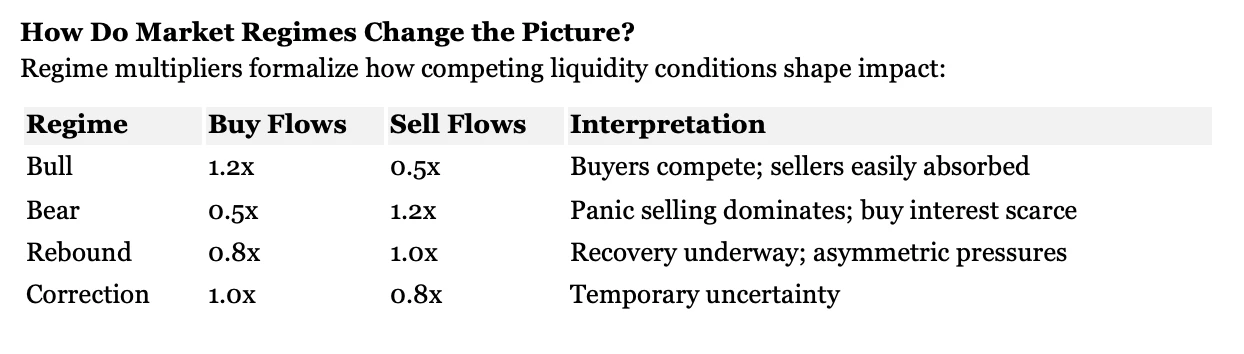
These adjustments embed behavioral and structural asymmetries consistently seen in crypto trading.
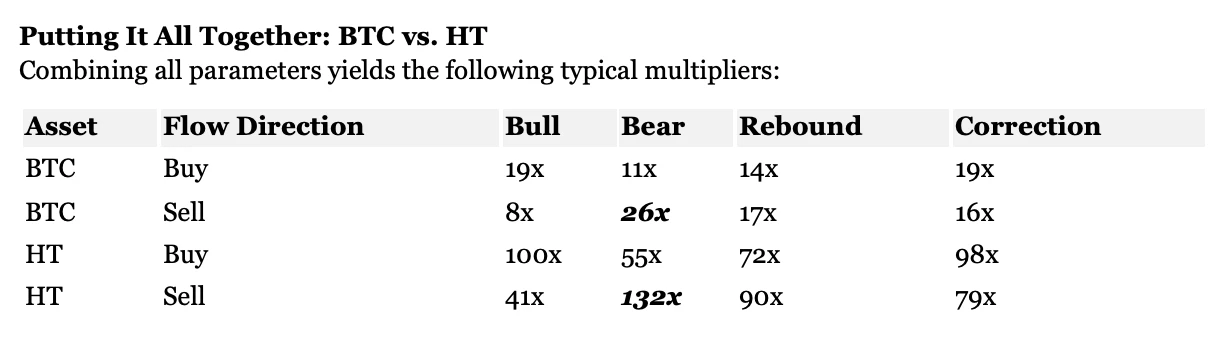
These results highlight the strong asymmetries across assets and regimes. In particular, HT’s bear-market sell multiplier of 120x reflects the token’s thin liquidity, concentrated ownership, and heightened fragmentation effects, while BTC’s 26x bear-market sell impact underscores how even highly liquid crypto assets can experience nonlinear price effects under stress.
How Well Does the Model Match Real-World Events?
Two real episodes validate the framework: the BTC ETF launch in 2024 and the BTC correction and recovery in 2025.
ETF inflows of USD 15–25B produced a ~26x market-cap response, consistent with the model’s bull-market multiplier of ~19x once extraordinary competition among institutional buyers is accounted for.
Observed multipliers during recent market episodes show that sell flows in correction phases reached 35–45x, far above the model’s baseline estimate of roughly 16x, while bear-market buy flows fell within the 8–12x range, closely matching the model’s 11x prediction. Rebound-phase flows similarly aligned with expectations, coming in at 12–17x versus the model’s 14x. Overall, the model tracks non-panic conditions well but consistently underestimates the severity of liquidation cascades, indicating that episodes of panic selling likely require an additional, dedicated cascade factor to capture their nonlinear dynamics.
What Portion of Impact Is Temporary vs. Permanent?
Classical microstructure research separates temporary (liquidity-driven) and permanent (information-driven) price impact. In decentralized crypto markets, this distinction becomes philosophical: “information” may arise not from fundamentals but from supply extraction or structural holder preferences. For BTC, persistent impact appears to be ~30–40% of total multiplier. For HT, persistence is higher (~50–60%), reflecting segmented liquidity and slower decay mechanisms. This decomposition highlights why crypto markets often show lasting effects from large flows, even when the initial price spike or drop seems outsized.
Conclusion
Crypto market impact is not a mystery, but the predictable consequence of measurable microstructural constraints. The market cap multiplier framework creates a unified way to quantify how liquidity, volatility, fragmentation, execution behavior, and market regimes interact.
While BTC behaves similarly to a highly liquid large-cap equity, assets like HT exhibit multipliers an order of magnitude larger. Understanding these dynamics is essential for institutional allocators, market architects, risk managers, and regulators aiming to interpret price movements in a rapidly evolving market structure.
About the Authors
Article authored by Dr. Siddharth Naik, PM (Systematic Strategies) at G-20 Group, Dr. Timothy Sharp, CQO at G-20 Group, Jonathan Mathai, CPO at G-20 Group and Dr. Nagendra Bharatula, Founder & CEO at G-20 Group
- Market
- Liquidity

