
Prediction Markets: The Rise of Event-Driven Finance
Executive Summary
● Prediction markets have emerged as a growing category of event-based financial contracts designed to reflect market-implied probabilities. By requiring participants to back real-time assessments with capital stakes, these markets produce live, financially backed probability signals that minimize latency and have, in certain contexts, demonstrated forecasting accuracy comparable to, or better than, traditional polling methodologies.
● From January through May 2026, prediction markets generated over US$92.6 billion in trading volume, surging by 18-fold year-over-year.
● Compliant platforms like OG, powered by the Commodity Futures Trading Commission (CFTC)-regulated Crypto.com | Derivatives North America (CDNA), demonstrates how the industry uses regulated clearing houses to overcome legal, tax, and liquidity challenges while maintaining high user engagement.
-
Legal Clarity and Institutional Trust: They provide regulated market infrastructure and legal certainty that unregulated platforms cannot match.
-
Potential Tax Considerations: Unlike sportsbooks or unregulated venues, trading on compliant platforms may be subject to tax treatment that differs from gambling activities depending on applicable law and individual circumstances.
-
Institutional Liquidity: Integrating with leading institutional market makers allows these platforms to ensure deep, reliable liquidity pools.
-
Robust, Deterministic Settlement: Using trusted third-party data and established clearinghouse protocols can guarantee fast, tamper-proof contract resolution, bypassing blockchain-based oracle delays.
● These markets are evolving into an "intelligence layer". By converting dispersed data into market-implied probabilities, they offer institutional-grade datasets for risk management and forecasting. The future of event-driven finance depends on institutionalization and modern infrastructure bridging traditional and digital markets.
1. Introduction
Prediction markets are evolving into event-driven data infrastructures where probabilities quantify sentiment and collective intelligence becomes tradable data. Unlike static polls, real-money stakes drive live price fluctuations to offer accurate, real-time signals of market expectations. Traditional finance increasingly views event data as a monetizable asset class, applying these market insights at scale.
Trading volume on these platforms saw a 18-fold year-over-year increase, exceeding $92.6 billion between January and May 2026. Supported by deep liquidity, this surge underscores the growing significance of prediction market probabilities as institutional data feeds.
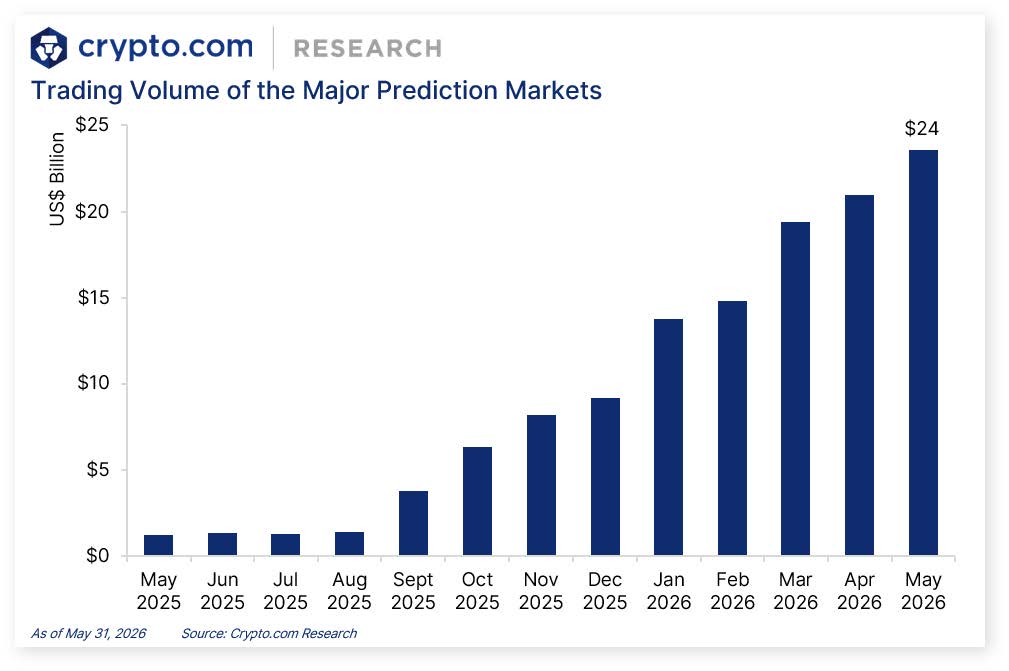
As prediction markets gain adoption in politics, economics, and sports, the sector is splitting into regulated institutional frameworks and fragile unregulated platforms. This report examines how compliant platforms leverage robust regulatory oversight to solve legacy issues like legal clarity, tax treatment, liquidity, and clearinghouse-backed dispute resolution while maintaining high engagement.
2. Core Components and Structural Advantages
Event Contracts and Real-Time Probability
Prediction markets rely on binary event contracts consisting of a "Yes" share and a "No" share. Trading between $0.00 and $1.00, the contract price maps directly to a crowdsourced, market-implied probability (e.g., a $0.65 contract reflects a 65% probability). Winning contracts settle at $1.00, while losing ones expire at $0.00. This structure enables automatic order inversion — where bids for “Yes” mirror asks for “No” – preventing order book fragmentation and ensuring deep liquidity.
Under the Commodity Exchange Act (CEA), event contracts offered by regulated platforms are classified as fully collateralized swaps. For institutions, these contracts provide powerful hedging mechanisms to manage portfolio exposure against macroeconomic shifts, regulatory rulings, or corporate mergers.
Regulatory Compliance and Institutional Legitimacy
Regulatory status is a core industry differentiator. While unregulated platforms face severe legal headwinds and structural vulnerabilities, platforms operating under a CFTC-registered DCM and DCO – such as the CDNA infrastructure – are designed to support market integrity and customer protections. Continuous compliance reviews and mandatory audits ensure listed contracts protect participants from platform fraud, counterparty defaults, and arbitrary settlement disputes. This framework provides the legal certainty indispensable for attracting institutional capital and sustaining mainstream trust.
Potential Tax Considerations
The classification of a contract can significantly influence its tax treatment. Platforms structured as sportsbooks generally adhere to standard gambling tax frameworks, which often impose specific limitations on loss deductions.
Conversely, contracts structured under a CFTC-designated derivatives framework may be subject to different tax considerations, contingent upon the specific contract classification and the taxpayer's personal circumstances. Users are advised to consult with tax professionals to assess their specific position.
Trading Architecture
High-performance prediction markets utilize a central limit order book (CLOB) matching engine governed by price-time priority. By managing order matching via institutional-grade database architectures while maintaining transparent, regulated clearing structures, compliant exchanges achieve ultra-low latency and deterministic routing. This infrastructure is designed to reduce execution latency and certain forms of trading inefficiency, mirroring the operational sophistication of traditional equity and derivatives exchanges.
Oracle Design and Settlement Integrity
The reliability of a prediction market hinges on its resolution mechanism, or oracle. Regulated platforms prioritize speed and absolute trust by anchoring contract resolutions to legally binding, unambiguous third-party data feeds. This institutional approach is intended to facilitate efficient and reliable settlement.
In contrast, blockchain-based protocols often rely on complex crypto-economic or optimistic oracles, which may face different operational challenges regarding latency and governance vulnerabilities inherent in token-voting systems.
Liquidity Provision and Incentives
Market makers provide the majority of liquidity by quoting both sides of the order book. When a customer buys or sells, they are typically interacting with this liquidity provider. This works similarly with the traditional equity orderbooks.
Advanced platforms rely on institutional market makers, ensuring robust and deep liquidity pools. These platforms typically implement efficient maker-taker fee structures where makers (liquidity providers) earn rebates while takers (liquidity consumers) pay fees, promoting continuous liquidity.
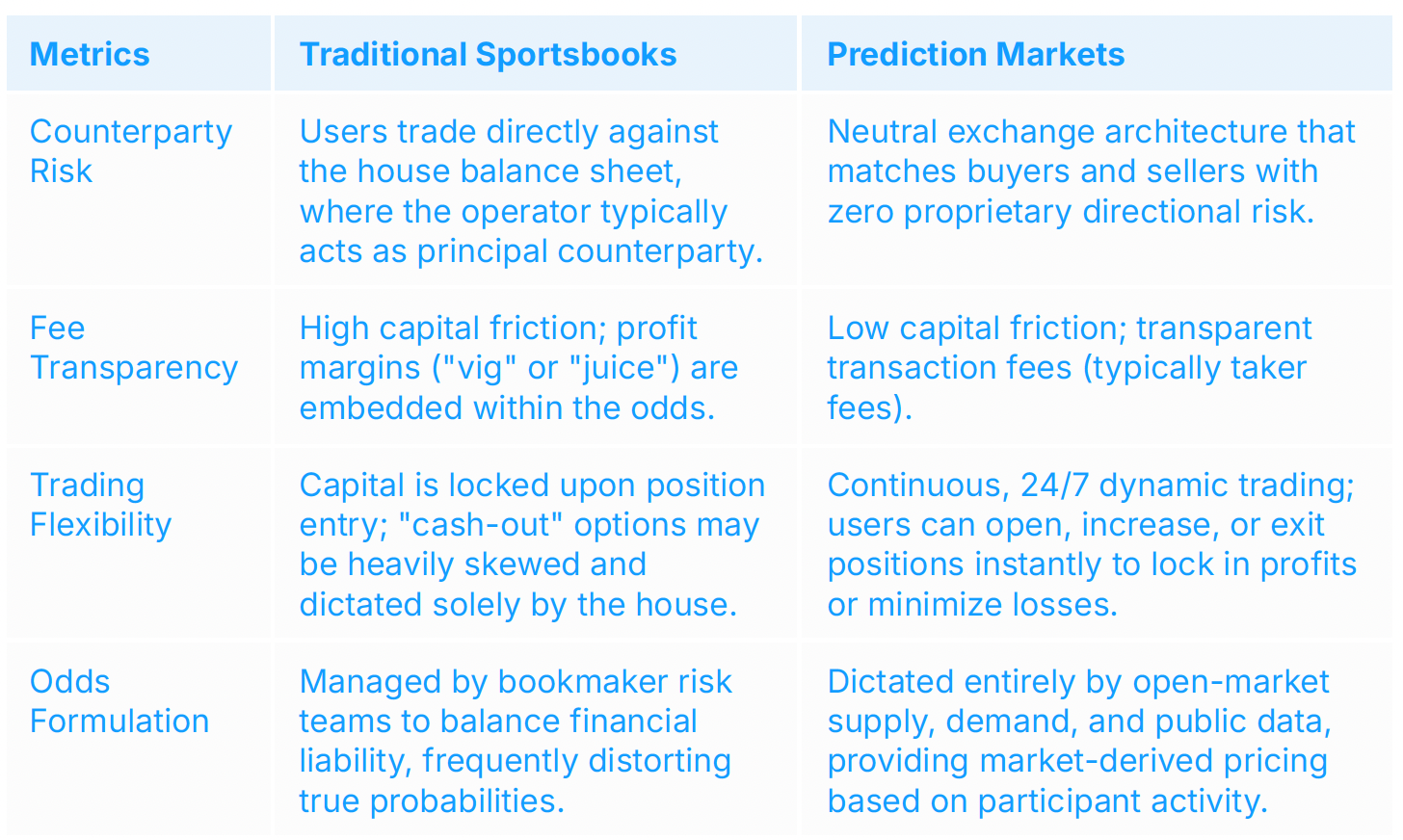
3. Prediction Markets vs Traditional Sportsbooks
The structural divergence between prediction markets and traditional sportsbooks highlights the economic advantages of exchange-based models:
Key Risks of Prediction Markets
While exchange architectures offer superior efficiency, participants must consider the distinct risks tied to platform structure and compliance:
- Insider Trading and Market Manipulation: Specific event focus makes these markets vulnerable to asymmetric information. Insiders or wealthy actors may exploit material non-public information or manipulate events to secure unfair payouts.
- Liquidity and Capital Constraints: Thin order books in niche markets cause wider spreads and price slippage. Mandatory full collateralization also limits capital efficiency compared to leveraged traditional derivatives.
- Regulatory Uncertainty: Prediction markets operate in a complex, evolving regulatory landscape. Conflicting oversight from the CFTC and other regulators creates risks of jurisdictional bans.
Conclusion
Prediction markets have gained significant retail and institutional traction, serving as vital real-time probability engines, alternative data feeds and hedging tools. Their continued integration into the global financial ecosystem necessitates adherence to rigorous regulatory and operational standards:
- Economic Utility: Contracts must align with established price discovery and information aggregation criteria to ensure verifiable value for the public interest.
- Market Integrity: Robust market-conduct oversight frameworks are essential to mitigate asymmetric information risks and prevent manipulation.
- Infrastructure: Scalability requires institutional-grade technology, including central limit order books and reliable data feeds, to ensure transparent, deterministic settlements.
Ultimately, the evolution of event-driven finance will be defined by the
convergence of institutionalization and modernized infrastructure, progressively
blurring the distinction between traditional and digital markets.
References
“Prediction Markets; Public Interest Determinations.” Federal Register, 12 Jun 2026, https://www.federalregister.gov/documents/2026/06/12/2026-11854/prediction-markets-public-interest-determinations.
Goldman, Nathan. “Prediction Markets Are The Tax-Advantaged Way To Gamble On Sports.” Forbes, 7 October 2025, https://www.forbes.com/sites/nathangoldman/2025/10/07/prediction-markets-are-the-tax-advantaged-way-to-gamble-on-sports/.
“Topic no. 409, Capital gains and losses | Internal Revenue Service.” IRS, 25 February 2026, https://www.irs.gov/taxtopics/tc409.
“Topic no. 419, Gambling income and losses | Internal Revenue Service.” IRS, 11 Jun 2026, https://www.irs.gov/taxtopics/tc419.
“Potential tax implications for CFTC sports events futures contracts.” KPMG International, 2025, https://kpmg.com/kpmg-us/content/dam/kpmg/pdf/2025/potential-tax-implications-cftc-report.pdf.
“What Is Vig in Sports Betting and How Does It Work.” FOX Sports, 27 April 2026, https://www.foxsports.com/stories/betting/what-is-the-vig.
Research Disclaimer
The information in this report is provided as general commentary by Crypto.com and its affiliates, and does not constitute any financial, investment, legal, tax, or any other advice. This report is not intended to offer or recommend any access to products and/or services. The views expressed herein are based solely on information available publicly, internal data, or information from other reliable sources believed to be true.
While we endeavour to publish and maintain accurate information, we do not guarantee the accuracy, completeness, or usefulness of any information in this report nor do we adopt nor endorse, nor are we responsible for, the accuracy or reliability of any information submitted by other parties. This report includes projections, forecasts, and other predictive statements that represent Crypto.com’s assumptions and expectations in light of currently available information. Such projections and forecasts are made based on industry trends, circumstances, and factors involving risks, variables, and uncertainties. Opinions expressed herein are our current opinions as of the date appearing in this report only.
No representations or warranties have been made to the recipients as to the accuracy or completeness of the information, statements, opinions, or matters (express or implied) arising out of, contained in, or derived from this report or any omission from this document. All liability for any loss or damage of whatsoever kind (whether foreseeable or not) that may arise from any person acting on any information and opinions contained in this report or any information made available in connection with any further enquiries, notwithstanding any negligence, default, or lack of care, is disclaimed.
Reproduction or dissemination, directly or indirectly, of research data and reports of Crypto.com in any form is prohibited except with the written permission of Crypto.com. This report is not directed or intended for distribution to, or use by, any person or entity who is a citizen or resident of, or located in a jurisdiction, where such distribution or use would be contrary to applicable law or that would subject Crypto.com and/or its affiliates to any registration or licensing requirement.
The brands and the logos appearing in this report are registered trademarks of their respective owners.
About the Author
Article authored by Crypto.com Research

