
OnChain, in Practice: How Blockchain Is Upgrading Private Credit
Private credit has surged from a $2T market in 2020 to over $3T at the start of 2025 and is projected to hit $5 trillion by 2029, according Morgan Stanley. Meanwhile, Apollo Global Management estimates that asset-backed finance (ABF) represents a $20T+ addressable market across trade finance, receivables, equipment, inventory, and other real-economy assets.
Despite this growth and vast potential, the infrastructure supporting private credit has remained outdated. Facilities have been managed through spreadsheets and disparate systems. The industry has scaled on top of rails that were built for a far slower, less data-intensive era.
Today, a new architecture is beginning to upgrade this model. Purpose-built to unify and modernize the full credit lifecycle, real-world deployments are already demonstrating how blockchain, tokenization, and smart-contract automation can transform private credit from a fragmented, manually managed industry into a faster, safer, and more accessible one. By re-architecting the rails from origination through payout, this emerging model enables quicker capital rotation, lower operational risk, and broader participation.
What follows is a closer look at how the shift toward modern credit infrastructure is already taking shape.
Why Does a Multi-Trillion Dollar Industry Still Run on Spreadsheets?
Despite the rapid expansion of private credit, its operational core has remained largely unchanged for decades. Trust has traditionally flowed through a network of third-party intermediaries, including trustees, servicers, verification agents, facility agents, and collateral administrators–each maintaining its own ledger and manually enforcing deal terms. As a result:
- Borrowing-base calculations are refreshed only every few days
- Collateral tapes are stitched together across PDFs, emails, and spreadsheets
- Waterfall calculations are done in Excel
- Settlement delays increase counterparty and operational risk
- Transparency for allocators and regulators is limited
- Mismatches emerge between asset velocity and liquidity
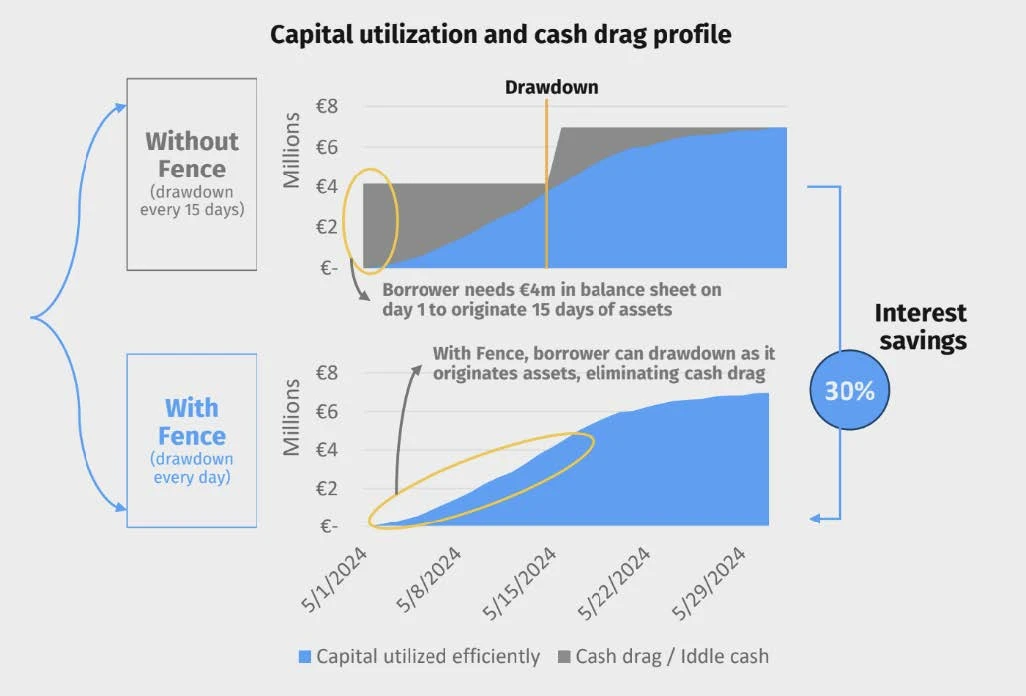
These inefficiencies add up. Cash drag, operational slippage, and reconciliation overhead can inflate financing costs by 20–30%. Capital frequently sits idle between batch drawdowns, weakening investor returns and pushing originators to rely on expensive equity to bridge
liquidity gaps. Meanwhile, allocators deploy large support teams to handle the operational overhead.
Today’s ABF portfolios-those backing BNPL receivables, SME loans, creator earnings, logistics invoices, etc.-can generate thousands of small dollar movements per week. This analog operating model is increasingly untenable for an asset class defined by high velocity and granularity and introduces a wide spectrum of vulnerabilities, from everyday human-introduced discrepancies to outright fraud.
Recent events highlight the consequences.
U.S. subprime auto lender Tricolor collapsed after lenders discovered double-pledged collateral, manipulated loan tapes, and misrepresented borrower quality, exposing severe failures in data integrity and tracking. HPS Investment Partners uncovered that certain telecom borrowers had fabricated two years of receivables and forged verification emails, leaving more than $400–500M of private credit loans backed by fictitious assets.
As payments and money movement grow more digital, automated, and high-velocity, the private credit ecosystem requires infrastructure that can keep pace.
From Trust by Intermediary to Trust by Design: The Rise of Programmable Credit
A new architecture for private credit, particularly in ABF and modern fintech lending, is now emerging. It collapses the many intermediaries into a singular infrastructure layer where trust, verification, and settlement can be executed by code on a shared ledger.
Smart contracts create the conditions for credit facilities to operate in real time; stablecoins enable synchronized funding and repayment cycles, eliminating cash drag and aligning liquidity with origination activity.
Instead of reconciling across siloed systems, participants operate from a single, auditable source of truth. Programmable money and programmable assets can reshape the operating model from end to end.
Real-Time Data as the New Credit Tape
Capital allocators want continuous and accurate visibility into their exposure. In a blockchain-enabled framework, asset-level data streams directly into the credit facility, enabling live NAV, ongoing borrowing-base updates, and automated covenant enforcement.
This is especially valuable for short-duration assets that recycle quickly but can overwhelm legacy batch-processing systems.
By moving the facility and incoming loan requests onchain, eligibility checks, margining, advance rates, drawdowns, repayments, and waterfall distributions can auto-execute based on preset conditions.
Platforms like Intain and Fence are already demonstrating measurable impact. In BBVA’s €20m revolving facility for Payflow:
- Payflow gained on-demand drawdowns, automated repayments, a ~30% reduction in interest expense, and 80%+ reduction in back-office work.
- BBVA achieved 80% lower operational cost, instant reconciliation, and continuous risk monitoring across 100k+ monthly transactions.
Source: Fence
The Upstream Advantage: Native OnChain Origination as the Final Unlock
While automated facilities can meaningfully reduce downstream frictions, especially when administering assets originated through traditional means, the largest unlock appears when blockchain is embedded directly at the point of origination. When loans are created natively onchain, they cease to be PDFs, data tapes, and monthly servicing files full stop.
Early movers are already heading in this direction:
- Figure originates HELOCs directly onchain, enabling instant lien creation, real-time verification, and fully automated servicing.
- Tare originates and services unsecured personal loans with smart contracts that enforce regulatory compliance, repayment logic, and debt covenants in a fully auditable and real-time manner.
In this model, the blockchain serves as the canonical record of assets and ownership, ultimately eliminating the need for trustees, servicers, verification agents, and custodians.
By removing traditional third-party service providers and their associated fees, native onchain origination has the potential to deliver both lower, more competitive borrowing rates and higher, cleaner returns for lenders.
Expanding the Participant Universe
For allocators, the implications are significant. Large managers such as Apollo and Blackstone can meaningfully reduce operational overhead, while smaller funds, emerging managers, and family offices can enter the market without the burden of building large back-office teams. This upgraded system can ultimately democratize access to a market historically reserved for only the largest institutions.
Over time, incumbents that remain dependent on manual, reconciliation-heavy workflows risk ceding ground to credit funds that embrace this modern infrastructure.
Where Do We Go From Here?
Digital assets are entering a more mature phase; a convergence of macro conditions, regulatory momentum, and institutional adoption is creating a strong foundation for blockchain’s integration into private credit. Developments like the GENIUS Act are helping unlock broader participation, while leading players are publicly signaling conviction. BlackRock describes the market as entering the early stage of tokenizing all asset classes and positions tokenization as a “bridge” connecting traditional finance and the digital asset world. Stripe, meanwhile, is accelerating its own commitment through strategic acquisitions and the launch of its own blockchain network.
Together, these signals indicate an ecosystem approaching an institutional tipping point. As more of the credit lifecycle moves onchain–from origination to servicing to capital allocation–the industry stands to capture meaningful gains in efficiency, transparency, and resilience. Looking ahead, private credit will increasingly be shaped by those who adopt updated operating models and the structural advantages they unlock.
About the Author
Article authored by Morgan Krupetsky, VP of OnChain Finance, Ava Labs
- Credit
- Tokenization
Recommended
-

- Bitcoin
- Bitcoin Layers
- Tokenization
Bitcoin Layers and the Path to Universal Utility
March 20, 2025 -

- Tokenization
Collateral Mobility: Unlocking the Next Phase of Tokenised Markets
December 18, 2025 -

- Blockchain
- Crypto
- Tokenization
- Asset Management
Do Crypto Assets and Tokenized Real Assets Protect Against Inflation?
October 14, 2020


