
Considerations for Private AI
Organizations pursuing AI face a basic question: where and how to deploy infrastructure. Public cloud services offer convenience but introduce dependencies, compliance risks, and cost unpredictability. Private AI infrastructure addresses these concerns by placing compute resources under direct organizational control, requiring careful planning across technical, operational, and regulatory dimensions.
Infrastructure Control and Customization
Private AI deployments allow organizations to configure infrastructure to specific requirements, rather than adapting to standardized cloud offerings. This includes custom power density for GPU-intensive workloads, network topologies optimized for inter-GPU communication, and cooling systems designed for high-performance compute clusters. Organizations can select hardware matching their workloads and implement orchestration tools that align with existing operational practices.
The ability to bring your own tooling matters. Teams standardized on Kubernetes, Slurm, Terraform, or custom frameworks can maintain existing workflows, avoiding staff retraining or automation rewrites. This continuity reduces migration friction and preserves institutional knowledge. For organizations handling proprietary algorithms or competitive intellectual property, air-gapped environments provide physical and logical isolation from external networks, addressing security and IP protection in a way shared public cloud infrastructure cannot.
Regulatory Compliance and Data Sovereignty
Regulated industries operate under constraints that shape infrastructure decisions. Healthcare must comply with HIPAA; financial institutions navigate customer data handling and geographic residency; government contractors face mandates on data processing and storage locations. Private AI infrastructure in North American facilities provides geographic certainty for data residency. Organizations know precisely where compute and data reside, simplifying compliance documentation and audit trails. Facilities aligned with SOC 2 and ISO 27001 standards provide baseline controls, while dedicated environments allow for additional, organization-specific security measures. Zero-trust network design, encrypted storage at rest, and comprehensive access auditing are practical to implement with full stack control. While these capabilities exist in the public cloud, configuration often involves navigating complex service matrices and accepting some multi-tenancy.
Performance Architecture
AI workloads stress infrastructure differently than traditional applications. Training large language models requires sustained GPU-to-GPU communication at scale. Inference serving demands low-latency response times. Data preprocessing generates enormous I/O loads. Private infrastructure can be optimized for these specific patterns. Access to current-generation GPUs (NVIDIA H100, H200, B200, GB200) matters for training performance. Private deployments can allocate resources based on actual workload requirements, not shared resource pool availability. Network architecture directly impacts training efficiency: InfiniBand offers low-latency, high-bandwidth GPU interconnects for tightly coupled jobs, while High-throughput Ethernet supports scale-out architectures and storage connection. The choice depends on model architecture, batch sizes, and communication patterns. Storage systems present optimization challenges: Large-scale training needs high-throughput access to datasets; real-time inference requires low-latency random access. Different storage architectures - distributed object, parallel file, or high-performance block - serve different profiles. Private infrastructure allows deployment of purpose-built storage.
Hybrid Deployment Models
Few organizations operate entirely on-premises or in the cloud. Private AI infrastructure can integrate with public cloud resources via hybrid architectures, allowing organizations to keep sensitive workloads on dedicated infrastructure while bursting capacity to cloud environments for specific tasks or peak demand. Linking private deployments to cloud GPU resources provides flexibility without full migration. Development and experimentation might occur in the cloud for rapid provisioning, while production training runs on dedicated infrastructure for predictable performance. Data preprocessing might scale horizontally in the cloud, while model training happens on tightly coupled private clusters. Cross-environment networking requires careful design. Low-latency links enable certain hybrid patterns; higher-latency connections constrain workloads spanning environments. Organizations must evaluate which components of their AI pipeline tolerate geographic separation and which require co-location.
Cost Structure and Predictability
Public cloud GPU resources follow on-demand pricing that fluctuates with utilization and market conditions. Sustained workloads accrue significant costs. Reserved instances offer discounts but require long-term commitments without workload visibility. Private infrastructure converts variable operating expense into capital expense and predictable operating costs. Organizations pay for capacity whether utilized or not, but they avoid per-hour charges that compound over months of training runs. For organizations with sustained compute requirements, the economics often favor dedicated infrastructure over time. Transparent pricing eliminates surprise bills, providing clarity for budgeting and capacity planning. This prevents optimization efforts from focusing on reducing cloud spend instead of improving model quality.
Operational Expertise and Support
Managing private AI infrastructure requires specialized knowledge in data center operations, GPU cluster management, network optimization, and storage systems. Organizations must either develop these capabilities internally or partner with providers. Support models are critical when runs fail or performance degrades. Engineers with infrastructure and AI experience can diagnose issues stemming from hardware, network congestion, storage bottlenecks, or software configuration. Round-the-clock availability aligns support with the reality that training jobs often run overnight. Long-term capacity planning requires understanding business trajectory and infrastructure scaling. Organizations benefit from partners who can model growth and identify expansion timelines.
Implementation Considerations
Deploying private AI infrastructure involves decisions about physical hosting, hardware procurement, network design, and operational responsibility. Organizations may colocate equipment in third-party data centers for power density and cooling, lease dedicated space, or build custom facilities. High-density power delivery (50kW+ per cabinet) supports modern GPU configurations. Direct liquid cooling addresses the thermal output more efficiently than air cooling at scale. These requirements shape facility selection and buildout timelines. Redundancy and uptime expectations must align with workload criticality (e.g., higher availability for production inference vs. training jobs that checkpoint). Infrastructure design should match these requirements.
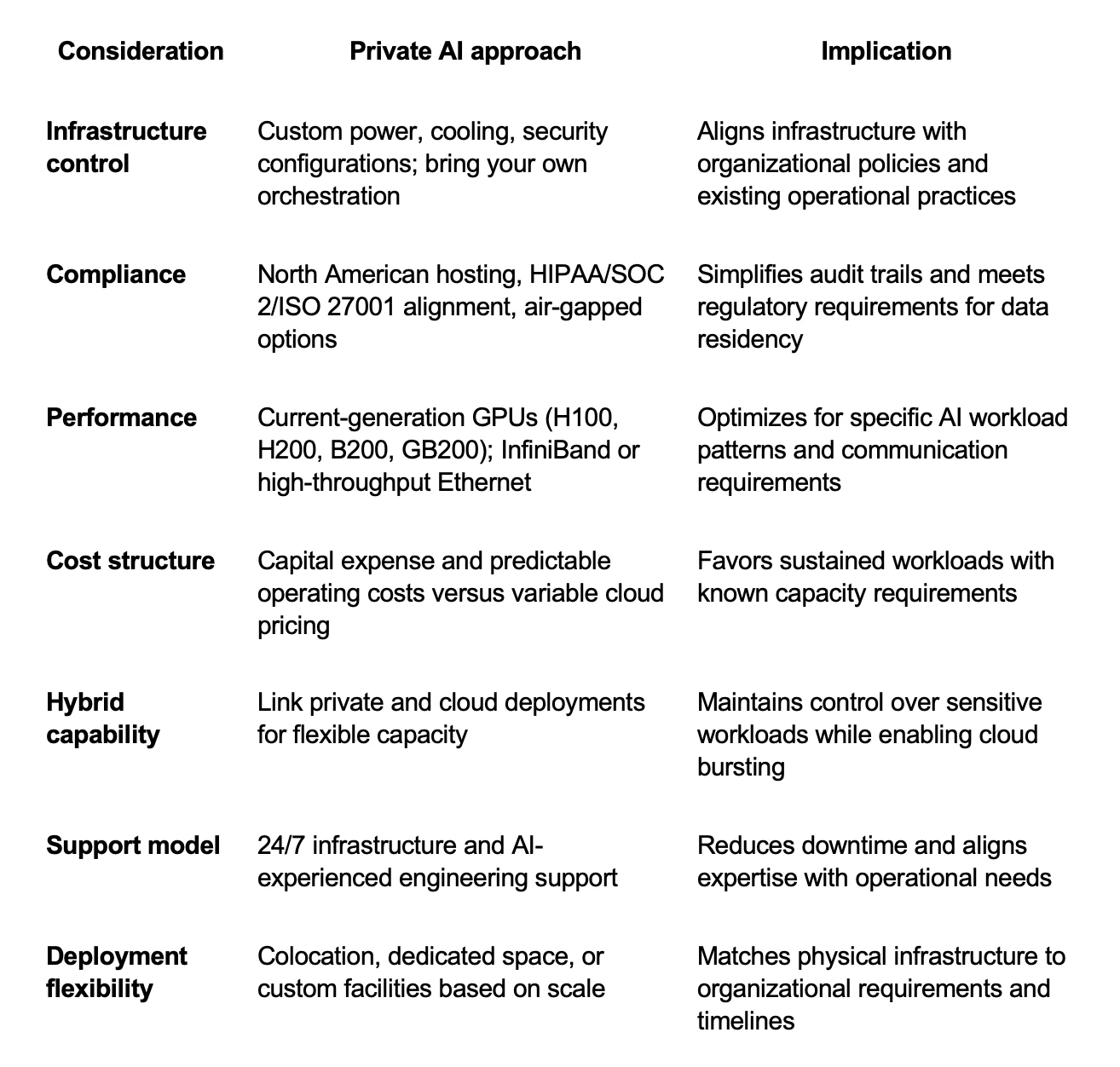
Private AI infrastructure serves organizations where control, compliance, performance optimization, and cost predictability outweigh the convenience of public cloud services. The approach requires upfront planning and operational expertise, but it delivers capabilities that shared infrastructure cannot replicate. Organizations must evaluate their workload characteristics, regulatory requirements, and long-term capacity needs to align deployment with their AI strategy.
About the Author
Article authored by Tom Sanfilippo, CTO, WhiteFiber
- AI
- Infrastructure
Recommended
-

- AI
- Infrastructure
Who Will Power the Infrastructure of Intelligence?
January 18, 2026 -

- Altcoins
- Blockchain
- Bitcoin
- Regulation
- Infrastructure
- Memecoins
2024: A Transformative Year for Crypto
December 19, 2024 -

- AI
- Blockchain
Blockchain and artificial intelligence – competition or convergence ahead?
December 06, 2023


